

The Upside Down Conspiracy
How federal connections inverted a state murder case

In the Netflix series, Stranger Things, the Upside Down is a shadow version of reality, familiar at first glance, but inverted. That metaphor fits what happened in the Karen Read case disturbingly well: cause and effect flip, assumptions harden into “truth,” and the danger isn’t obvious until you’ve ventured too far in and can’t see your way out.
Before we move forward, I have to give credit where it’s due: the “The Upside Down” comparison belongs to AnonyMassLawyer. I’m openly stealing it because it captures this case perfectly.
Because the real conspiracy here isn’t the one people have shouted about for years. It isn’t a cabal of cops framing an innocent woman. It isn’t planted taillights, basement attacks, garage fights, or dogs without DNA. Those stories live in the Upside Down.
The real conspiracy, the one that actually deserves scrutiny, is how federal connections, wealth, and influence quietly inverted a state murder case, reshaped public perception, and warped a trial environment without ever changing the underlying facts.
How the Case Flipped Into the Upside Down
At its core, this case should have turned on the evidence: vehicle telemetry, cell phone data, timing, steps, GPS, the physics of an off-center of mass pedestrian clipping event. Unlike Karen’s narrative, none of that has moved since day one.
What changed was the narrative. Once the U.S. Attorney’s Office for the District of Massachusetts entered the picture, the case crossed a psychological threshold. It no longer mattered what federal authorities ultimately found. The mere idea that the feds were investigating the investigators carried enormous weight. And Karen Read leaned hard into that framing. She repeatedly invoked the line that the feds don’t swing and miss, a shorthand meant to signal that something bigger was happening behind the scenes.
That message mattered because, at the time, no mainstream outlet would touch the story. There was little appetite to cover a messy local motor vehicle homicide with disputed evidence and imperfect police work. What changed wasn’t new proof; it was the implication of federal involvement. Karen’s insistence that the federal government was investigating the case helped convince Aidan Kearney to begin reporting on it. The logic was simple: if the feds were involved, then this wasn’t just noise.
Once that assumption took hold, everything else followed.
Proximity to Federal Power (A Map, Not an Accusation)
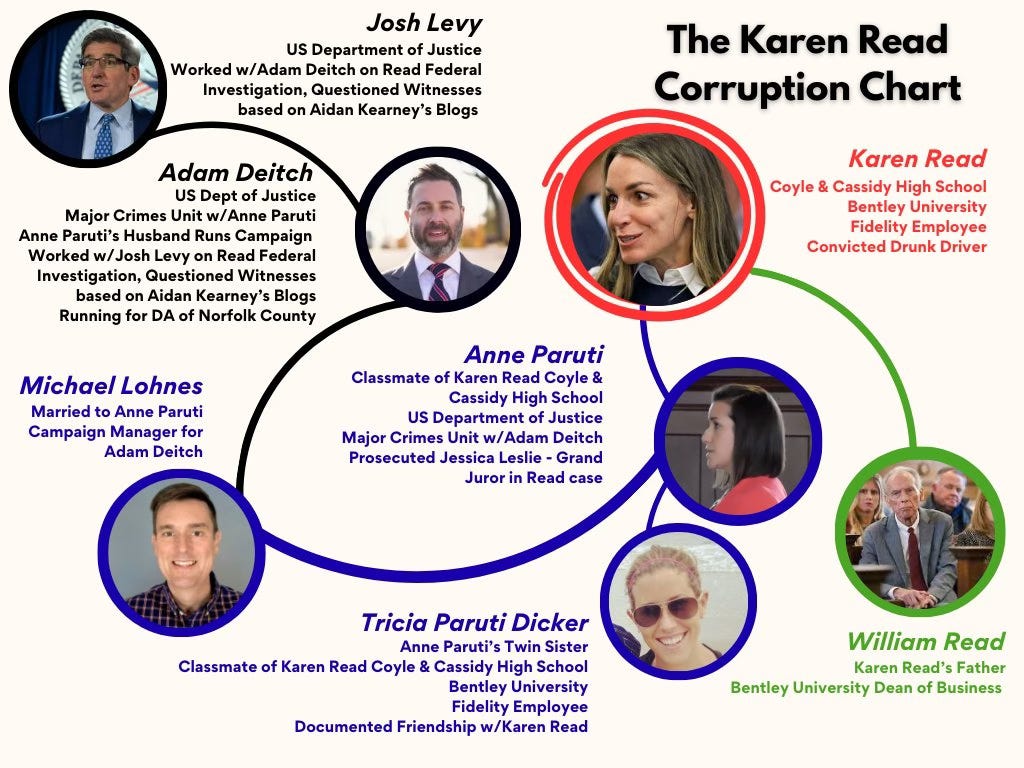
This is not a claim of coordination or misconduct. It’s a map of proximity, social, professional, prosecutorial, and political, that explains how federal doors opened.
Karen Read attended Coyle & Cassidy High School with twin sisters Anne and Tricia Paruti. Publicly visible social media show Read remained connected to Tricia Paruti for many years. Tricia Paruti also worked at Fidelity Investments, the same employer as Read.
Tricia’s twin, Anne Paruti, is a federal prosecutor with the U.S. Attorney’s Office. Anne Paruti later served as the lead prosecutor in the case against Jessica Leslie, who pleaded guilty to leaking non-public federal grand-jury information directly tied to the Read-related review. The government sought an extraordinarily lenient one-day-served sentence so unusual that a federal judge rejected it and increased it to 30 days.
The federal review itself was overseen by senior leadership at the U.S. Attorney’s Office, including Josh Levy, and involved Adam Deitch, who questioned witnesses before the federal grand jury. After leaving the office, Deitch decided to run for Norfolk County District Attorney; his campaign manager, Michael Lohnes, is married to Anne Paruti.
None of this proves wrongdoing. It does establish an undeniable point: Karen Read sat far closer to federal authority than any ordinary defendant would. That proximity mattered.
(Credit to Kate Peter and Kevin Linehan for surfacing and connecting these dots.)
Asymmetry No One Can Explain
In open court, the Commonwealth acknowledged that the U.S. Attorney’s Office refused to take its calls and never received a single investigative file. The federal review relied exclusively on defense-supplied materials. Key federal outputs, including Touhy-related materials, were not easily accessible to the prosecution. Special ADA Hank Brennan said in open court that the road to the Touhey Report is dark and leads to nowhere.
That isn’t neutrality. It’s asymmetry. Federal credibility accrued to one side while access was denied to the other.
The ARCCA Irregularity
During the first trial, sequestration orders were in place experts are not supposed to know the substance of other experts’ testimony. Yet the U.S. Attorney’s Office fed live play-by-play of the Commonwealth’s expert testimony to ARCCA experts Dr. Daniel Rentschler and Dr. Wolfe, information they were not supposed to have.
Why would the federal government insert itself into a state murder trial and then provide defense experts with testimony barred by sequestration?
That question has never been answered.
How the Narrative Was Fed
As the federal aura grew, Turtleboy became Read’s primary storyteller. By his own public statements, he was in frequent contact with Karen Read, her defense team, as well as with a “friend” of Jessica Leslie, saying they spoke “a million times.” Aidan Kearney covered the Read case exclusively for three years, so it begs the question, what did they talk about “a million times?” He functioned less as an independent investigator than as a conduit for non-public, defense-aligned misinformation.
At one point, a Turtleboy blog post itself was reportedly used as a visual blow-up during federal grand-jury questioning. That’s the Upside Down at work: blogs become sources; repetition becomes truth; influence replaces proof.
Media, Fear, and a Warped Trial
Without the backdrop of an “ongoing federal investigation,” no serious journalist would have touched this circus. With it, the story exploded, online hysteria followed, witnesses were harassed, judges were targeted, the victim’s family mocked, and jurors were placed in an environment where convicting felt dangerous.
Even the most baseless smear that Michael Proctor planted evidence grew out of the same soil. Proctor’s texts were offensive and inexcusable. But they showed bias and immaturity, not evidence tampering. In the Upside Down, that distinction no longer mattered.
The Pulitzer That Was Left on the Table
The real investigative story was never about corrupt cops. It was about how federal power was deployed, how access was asymmetrical, how sequestration was violated, and how a state murder trial was quietly inverted by connections, wealth, and influence.
If anyone should have chased that story, it was the Boston Globe Spotlight Team. This was a Pulitzer-level investigation hiding in plain sight, not because it would have exonerated or convicted Karen Read, but because it would have shown how modern power and corruption actually work.
We still have Bob Woodward and Carl Bernstein moments available. What’s missing isn’t opportunity, it’s courage.
At the End of the Day
Karen Read was found not guilty. That is the justice system functioning as designed, even if many of us strongly disagree with the outcome.
But the Upside Down Conspiracy remains.
It isn’t a secret plot. It’s a quiet inversion where access becomes authority, influence becomes proof, and federal involvement distorts reality without producing findings.
Without federal involvement, there was no conspiracy theory. There was no Turtleboy crusade. There was no “Free Karen Read” movement.
There was just a drunk driver, a dead boyfriend, and a tragic truth buried beneath a mountain of Upside Down fiction.
And that is the story that still deserves to be told.
Julie I enjoy watching you and the Fourensics from Florida. Topcop
Funniest thing I’ve read in a long time thanks